Per Shot Encoding

IRIS Adaptive Per-Shot Encoding analyzes every shot individually and allocates bits exactly where the picture needs them. Combined with IRIS Denoising, which removes noise before the encoder ever sees the signal, this delivers higher VMAF, fewer quality drops in demanding scenes and a more consistent viewing experience across the entire stream.

UHD in HEVC at 7.54 Mbit/s with 96.02 VMAF

April 29, 2026

Test material: Netflix "Meridian", encoded in HEVC and delivered via HLS in UHD at 59.94 fps.

7.54 Mbit/sBitrate, UHD @ 59.94 fps
96.02VMAF
5.06QBVE, lower is better
HEVC / HLSCodec and delivery

How? By removing noise from the signal before the encoder ever sees it, combined with IRIS Adaptive Per-Shot Encoding, which analyzes every shot individually and allocates bits with surgical precision. The result: higher VMAF, fewer quality drops in demanding scenes and a more consistent viewing experience across the entire stream.

Our customers see this every day, on their own material. If you want to see what it does to yours, let's talk.
#Streaming #HEVC #HLS #UHD #Broadcast #OTT #PerShotEncoding #VideoQuality #IRIS #VMAF #QBVE #WaveletBeam

How IRIS Per-Shot Encoding Works

  1. Denoise first: IRIS Denoising cleans the signal before it hits the encoder, so bits are spent on detail, not on noise.
  2. Analyze every shot: IRIS.ANALYST generates precise metadata for each shot in a single pass, without iterative VMAF loops.
  3. Allocate bits per shot: Every scene gets exactly the bitrate its complexity requires, for up to 30% bitrate savings.
  4. Deliver via HLS: Dynamic Per-Shot Encoding with HLS, in HEVC or AV1, with our in-house Film Grain Synthesis for AV1 VOD.

The entire pipeline runs as a fully automated process with flexible Kubernetes integration, as well as via Docker and VMs.

Per-Shot vs. Per-Title: Why One-Path is the Future

January 31, 2026

Traditional Per-Title encoding relies on exhaustive VMAF-driven loops that consume massive computing power and time. At Wavelet Beam, we believe efficiency should be inherent, not iterative. Our One-Path philosophy eliminates redundant analysis cycles.

The Wavelet Beam Advantage: Intelligent Precision

By leveraging IRIS.ANALYST, we generate precise metadata in a single step. This allows our Per-Shot Encoding to adapt instantly to the unique complexity of every scene, ensuring optimal quality without the overhead of multiple encoding passes.

  • IRIS-Denoising Integration: We clean the signal before it hits the encoder, ensuring bits are spent on detail, not noise.
  • One-Path Workflow: Metadata generation and encoding happen in a seamless, high-speed pipeline.
  • Up to 30% Bitrate Savings: Superior visual fidelity at significantly lower bandwidth through shot-based granularity.
#WaveletBeam #PerShotEncoding #IRISDenoising #OnePath #GreenStreaming

QBVE: Is it just a single glitch or a nightmare?

February 5, 2026

In high-end video encoding, averages can be misleading. At Wavelet Beam, we've seen cases where a video achieves a "Mean VMAF" of 95, yet contains visible quality collapses that ruin the viewer experience.

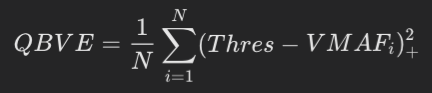
QBVE Formula

The Wavelet Beam Solution: QBVE

We utilize QBVE (Quadratic Bad VMAF Energy). Unlike standard means, QBVE functions as a Gated MSE, measuring the failure energy only when it falls below our quality floor:

QBVE Diagram Comparison

Comparison: Standard Encode (QBVE 9.46) vs. Wavelet Beam IRIS (QBVE 5.06).
Double-click to open. Single-click to zoom.

While the standard encoder (left) struggled, our IRIS per-shot optimization (right) preserved structural integrity and nearly halved the "Bad Energy."

#WaveletBeam #VMAF #QBVE #VideoQuality #IRIS

Frequently Asked Questions

What is per-shot encoding?

Instead of one bitrate ladder for a whole title, every shot is analyzed and encoded with exactly the bits its complexity needs. IRIS.ANALYST generates the metadata in a single pass, without iterative VMAF encoding loops.

How much bitrate can IRIS per-shot encoding save?

Up to 30%. One example: Netflix "Meridian" in UHD at 59.94 fps, encoded in HEVC and delivered via HLS at 7.54 Mbit/s with a VMAF of 96.02 and a QBVE of 5.06.

What is QBVE?

QBVE (Quadratic Bad VMAF Energy) only measures the failure energy below a quality floor, for example VMAF 93, and squares the deviation. Short, visible quality drops can therefore not hide behind a high average VMAF.

Which codecs and delivery formats are supported?

HEVC and AV1, delivered via HLS. The pipeline runs fully automated with Kubernetes integration, as well as via Docker and VMs.