IRIS FOR AI: BROADCAST, EDGE-AI & MACHINE VISION

Clean signals for AI models in live broadcast, AI cameras, CCTV analytics and autonomous systems

New Article, September 26, 2026

Why do AI video models in broadcast environments often fail when moving from testing to live transmission?
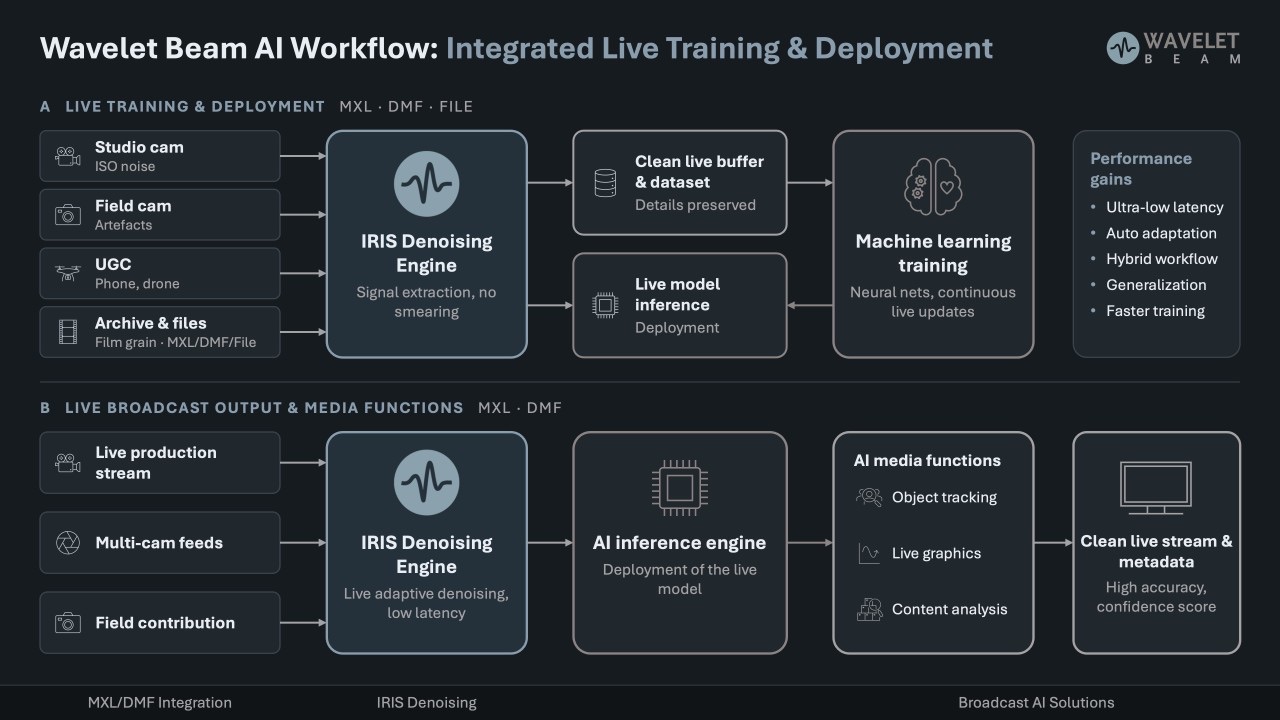
Wavelet Beam AI Workflow: integrated live training and deployment with the IRIS Denoising Engine, MXL and DMF

Broadcasters operate with an unpredictable mix of camera sources: studio setups, field cameras, drone feeds, archives and user-generated content. Every source brings its own sensor noise, gain artifacts and heavy video compression.

During AI model training, neural networks fall into shortcut learning. Instead of analyzing real scene content, they learn specific sensor noise signatures or compression artifacts. As a result, when an automated camera tracking or live object detection system encounters a different camera feed, its detection confidence drops immediately.

Standard denoising solutions fail in broadcast because they simply blur or smooth the picture. Blurring wipes out fine textures, sharp edges and essential detail, stripping away the exact information AI models need to make accurate predictions. At Wavelet Beam, we solve this bottleneck for broadcast pipelines using IRIS-Denoising.

Why IRIS-Denoising Changes the Game for Broadcast AI

  • Signal extraction without blurring: IRIS-Denoising does not smear or flatten video data. It isolates and lifts the true visual signal straight out of the noise. Fine details, high-frequency textures and crisp edges are fully preserved, delivering clean, high-contrast feature maps for neural networks.
  • Fully automatic across any broadcast feed: Broadcast engineers do not have time to manually tune noise profiles during live productions. IRIS Video-Denoising adapts dynamically to changing ISO levels, low-light gain or aggressive codec compression across every incoming stream.
  • Higher inference accuracy for automated workflows: Whether for live player tracking, automated graphic overlays or AI-driven stream moderation, cleaner input signals directly improve bounding box precision, tracking continuity and overall confidence scores.
  • Built for live broadcast infrastructures: IRIS-Denoising operates seamlessly in both file-based offline environments and live workflows via MXL and DMF integration.

At Wavelet Beam, we are also building AI-based Media Functions that integrate directly into live broadcast pipelines, enabling high-precision AI processing with minimal latency.

Read and discuss this article on LinkedIn

#IRISDenoising #WaveletBeam #BroadcastEngineering #LiveProduction #ComputerVision #VideoAI #BroadcastAI #DMF #MXL #IRIS

Edge-AI, Machine Vision and Video Coding for Machines

The paradigm shift from human-centric to machine-centric video encoding starts with one unavoidable prerequisite: a clean signal. That is exactly what IRIS delivers.

The Shift: From Human Perception to Machine Inference

For decades, video encoding was optimized for human viewers: PSNR for mathematical fidelity, SSIM and VMAF for perceptual quality. Artificial intelligence has fundamentally different requirements. It does not care whether a picture looks beautiful. It needs feature preservation, temporal consistency, inference-relevant frequencies and maximum information density.

Where IRIS Sits in the VCM Stack

Video Coding for Machines (VCM) defines a four-layer architecture. Many VCM solutions assume clean input and start at layer 2 or 3. IRIS owns Layer 1, Signal Conditioning, the layer that sets the ceiling for everything above it. IRIS.ANALYST extends this into Layer 2 with per-shot complexity metadata that machine-optimized encoders can act on directly.

The Edge-AI Pipeline Problem

A modern CCTV deployment produces 4K video 24/7 across hundreds of cameras. 99.9% of that footage contains no relevant event. The industry is shifting from central-server analysis of raw streams toward edge-based inference, transmitting only events, metadata and compressed reference video. IRIS improves inference quality at the edge while simultaneously reducing the bitrate of any reference stream that must be transmitted.

Relevant Market Segments

CCTV and video analytics platforms · Edge-AI SoC and camera silicon vendors · Video Management Systems · Cloud video analytics · Streaming and CDN encoding infrastructure · Autonomous systems (robotics, ADAS, UAV) · MPEG VCM standardization working groups

Frequently Asked Questions

Why do AI video models fail when they move from testing to live broadcast?

Broadcast uses a mix of studio, field, drone, archive and user-generated sources, each with its own noise and compression artifacts. During training, networks fall into shortcut learning and learn these signatures instead of scene content, so detection confidence drops on a new camera feed.

Doesn't a standard denoiser solve this?

No. Standard denoisers blur or smooth the picture and remove fine textures, sharp edges and detail, which is exactly the information AI models need for accurate predictions.

How does IRIS improve AI inference?

IRIS-Denoising lifts the true signal out of the noise without blurring, fully automatically, and adapts to changing ISO levels, low-light gain and codec compression. Cleaner input improves bounding box precision, tracking continuity and confidence scores.

Does IRIS work in live workflows?

Yes. IRIS runs in file-based environments and in live workflows via MXL and DMF. We are also building AI-based Media Functions for live broadcast pipelines.